What makes an election a good election?
Elections are central to democratic government, but their quality varies enormously. Problems can arise at every stage of the electoral process—from registration and campaigning to voting, counting and the acceptance of results.
My research examines what electoral integrity means, how it can be measured, why election quality varies, and what governments, electoral authorities and civil society can do to strengthen elections.
A central theme is that elections should be judged not simply by whether rules and procedures are followed, but by whether they enable citizens to exercise meaningful political power.
What is electoral integrity?
There are competing ways of defining a good election. Elections can be assessed against national law, international standards, public expectations or democratic principles.
My work with Holly Ann Garnett develops an explicitly democratic conception of electoral integrity. We define it around human empowerment: elections should give citizens a meaningful voice, enable them to challenge those who hold power, and contribute to political equality.
This approach identifies several democratic principles that elections should help realise, including:
- Contestation — All groups, individuals and parties
to compete in the election in a fair
environment.
- Participation — There is wide and even
participation across the whole
population.
- Deliberation — Debate is led by evidence, seeks
consensus and is free from hate
and discrimination.
- Adjudication — Elections are conducted in line
with the law, laws are designed
fairly, and there are clear
processes for raising and dealing
with complaints.
The argument is developed in our 2026 Cambridge University Press book:
How can electoral integrity be measured?
How can we tell whether elections are working well?
My research uses and develops several approaches to measuring election quality.
One important source is expert assessment. The Electoral Integrity Project’s Perceptions of Electoral Integrity dataset draws on country specialists to assess different stages of the electoral cycle and provides comparative evidence across elections and countries. The Project’s annual Global Electoral Integrity Report uses these data to identify patterns, strengths and weaknesses in elections worldwide.
I have also developed practitioner-based measures with colleagues. Electoral officials possess experience and technical knowledge that may not be visible to citizens or external experts, making their perspectives another valuable source of evidence about how elections function.
Using different forms of evidence enables election quality to be examined from several perspectives rather than relying upon a single indicator
How does electoral integrity quality around the world?
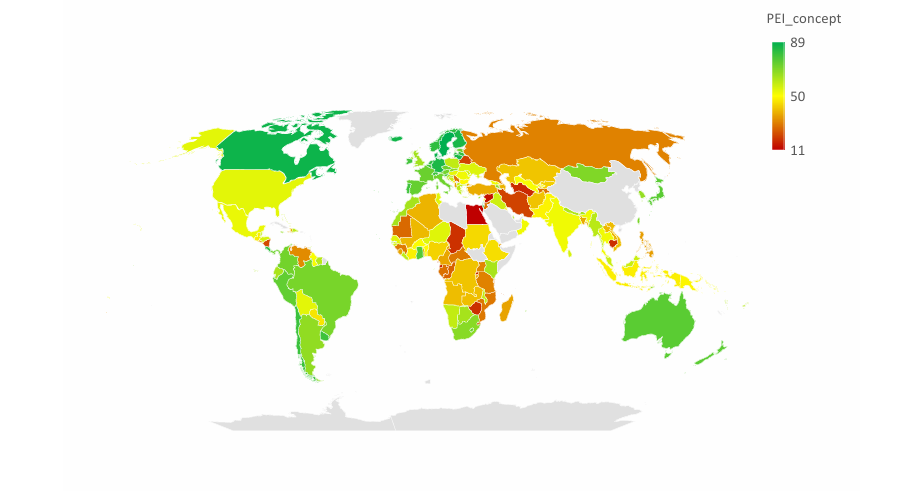
The Electoral Integrity Project’s Annual Global Electoral Integrity Report provides an overview of global patterns of electoral integrity. This is based on the open-source Perceptions of Electoral Integrity Index.
Below is the map of electoral integrity in the 2025 report.
What can improve electoral integrity?
A further strand of my work is concerned with practical reform.
My research has shown that useful reforms can include:
- Automatic voter registration
- Poll worker recruitment
- Financial investment in electoral management
- International best practice documents
- Not using onous voter identification requirements
- Postal voting with security provisions
- Comparative SWOT against sister countries
- Benchmarking electoral officials’ performance
- Poll worker training
- Building inclusive networks to inform policy making
- Avoiding complex laws
- Electoral risk management approaches
Also see research on specific aspects of electoral integrity: