
Football (‘soccer’) is the world’s largest sport.
World cups mark major international mega events, which can trigger economic development, and have wider cultural and political consequences. The size of the global industry has exceeded €38 billion in Europe alone. Around the world, over 200 national associations, 130,00 professional players, and 4,000 professional teams. At the everyday level, there are an estimated 3.5 billion fans. There are an incalculable number of grassroots and occasional recreational players, with the game playing a central role in enabling people to realise their capabilities – and address social exclusion in marginalised communities.
The sport therefore has widespread consequences for national and political culture, economies, development, politics, public health, and well-being.
And yet, there are also concerns about the quality of governance, corruption, role of money, discrimination and underlying inequalities. It is commonly claimed that political leaders and states use sporting success to ‘sportswash’ wider political agendas. Disproportion power is thought to be held by rich billionaires, TV networks and advertisers. Many professional and amateur clubs face uncertain financial futures. Opportunities can be limited – especially for pan-disability programmes. Misogyny, homophobia and racism remain endemic in many spaces.
The systems of governance and policies developed at all levels are therefore a central concern. There are a variety of institutional levers, laws, guidance and policies which can be enacted – from the FIFA boardroom, national football associations, to the grassroots playing field. These, in turn, rely on mechanisms for implementation.
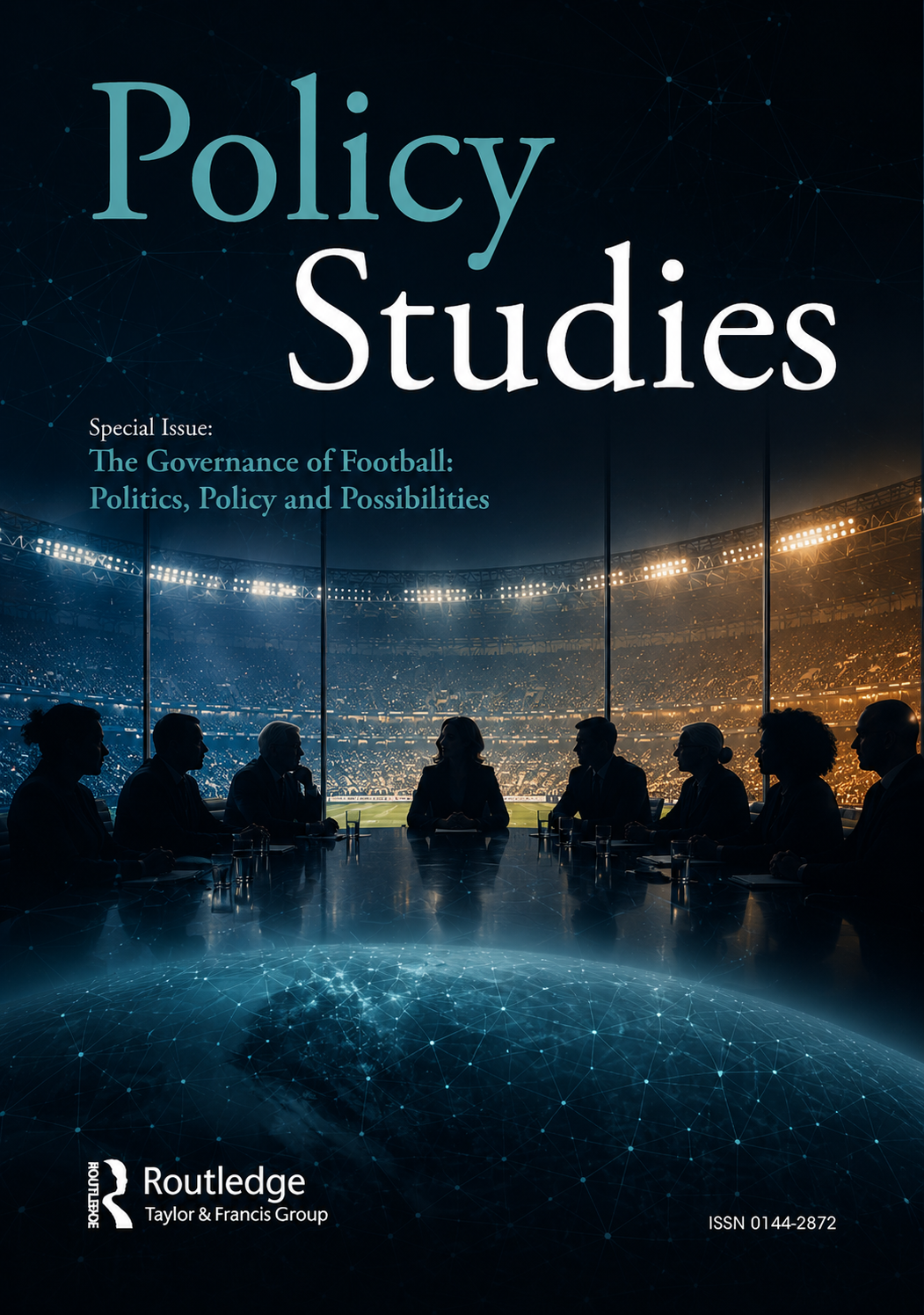
Policy Studies invites papers for a special issue on The Governance of Football: Policy, Politics and Possibilities.
The special issue welcomes papers on, but not limited to:
- The quality of governance of football, either at international, national or sub-national levels
- Evaluations of policies aimed to improve football governance
- The politics and international relations of football
- Evaluations of policy problems and solutions within football
- The effectiveness of measures to redress inequalities and build inclusion in the sport
Papers can come from any discipline including: public administration, law, business studies, political science, economics, sports management, international relations.
The geographical scope is global covering all levels of the sport.
Deadline for submission: 1 April 2027 (but papers will be considered, reviewed and published on a rolling basis)
Articles could be:
- Full research articles
- Commentary pieces
- Data Notes
Articles should be anchored and contribute towards the broader literature. They should be rigorous in their methods – but also aim to be accessible in their use of language to a broad policy and academic audience (some statistical methodological detail could be included in an appendix, for example).
Informal inquries can be sent to : t.s.james@uea.ac.uk.
Papers should be submitted to the Policy Studies website. They will all be subject to peer review.

