Democracy and Democratic Backsliding

Throughout the world, scholars and international organisations have voiced their concern in recent years that democracy appears to be ‘backsliding’ (Hellmeier et al. 2021; International IDEA 2021). These forms of backsliding are often described as taking a different form – with open-ended coups d’état and state violence being replaced with promissory coups, executive aggrandizement and strategic electoral manipulation described as being more common (Bermeo 2016; Runciman 2018; Levitsky and Ziblatt 2018). The pandemic has been presented as an opportunity for autocratic leaders to restrict freedoms and extend states of emergency (Edgell et al. 2021). In response to these challenges, a Summit for Democracy was hosted by the United States in December, to start a year of action that would aim to ‘to strengthen our own democracies and push back on authoritarianism, fight corruption, promote and protect human rights of people everywhere’ (Biden 2021).

What is Democracy?

Research explores how concepts of democracy can be connected to positions in the social sciences. This concept paper sets an alternative approach for conceptualising democracy, drawing from critical realist theory:

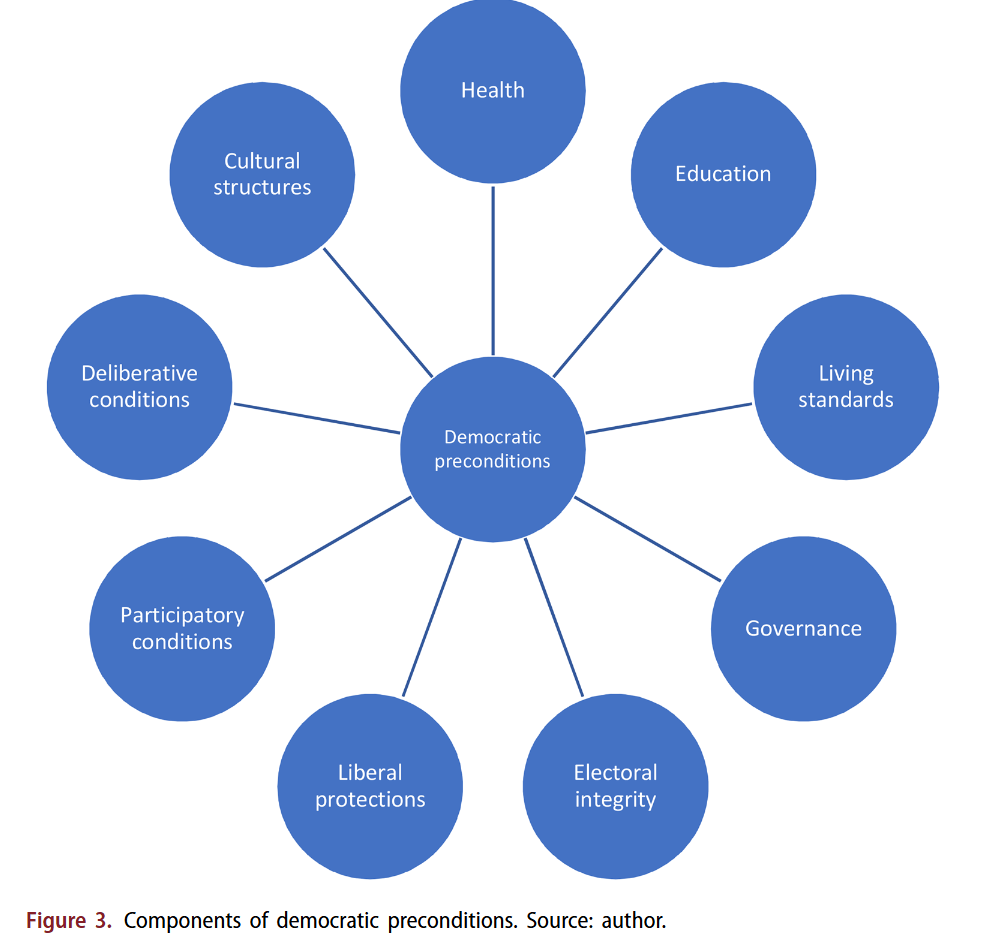
This article presents an alternative general model of democracy to traditional minimalist (electoral and liberal) and deliberative theories by drawing from critical realist philosophical thought.   Realist or real democracy is proposed as a societal system where preconditions exist to fully empower all citizens to realise their individual capabilities.   This includes empowerment opportunities at the ballot box – but also other preconditions such as health, educational and living standards. Real democracy also separates democratic preconditions from democratic outcomes.  Democratic outcomes require the absence of inequalities in power as result from the contingent interaction preconditions and human agency.  The new approach is argued to provide a more holistic and dynamic concept of democracy which is also more grounded in the everyday experience of the citizen compared to traditional approaches.  It reconnects democracy with theories of human development and enables a new classification of political regimes and conception of democratic politics.  An initial empirical mapping of patterns of global real democracy shows evidence of rising preconditions since 1990 – but stagnation since 2010 and some signs of decline.  Democratic outcomes by socio-economic position saw the most notable decline.

UK Democratic Backsliding?

A new report on the extent of democratic backsliding in the UK, funded by Unlock Democracy.

Blog: After the Johnson years it is time to renew British democracy

Electoral Backsliding?

A special issue of Electoral Studies on Electoral Backsliding looking at whether the quality of elections has declined around the world.

Read: ‘Electoral backsliding? Democratic divergence and trajectories in the quality of elections worldwide‘, Electoral Studies (with Holly Ann Garnett).

Democratic Backsliding and Public Administration

A call for papers on Democratic Backsliding and Public Administration is now open: https://tobysjames.com/democratic-backsliding-and-public-administration/