
In an age of ‘democratic backsliding’ it is worth re-asking… ‘what is democracy?.’ This new piece in New Political Science draws from a tradition in British philosophy to propose an alternative to traditional minimalist and deliberative approaches to democratic thought.
Realist (or real) democracy is present where preconditions exist to fully empower all citizens to realize their individual capabilities – and there is equality of power.
A longer book version is under contract and in progress for Manchester University Press.
What is Real Democracy?
For those not familiar with critical realism, it is a stream of philosophical thought pioneered by Roy Bhaskar, Margaret Archer et al. It has spread worldwide with international networks and conferences. It is Archer’s work that I use predominantly in this article and to whom many, including myself, owe much intellectual debt.
At its core, the approach holds that social structures always pre-exist humans and agents – but that human agency is necessary for the reproduction of social structures and is capable of changing them over time. The approach has been used to explore lots of empirical areas of society but there is no critical realist theory of democracy – so the article sets out on the challenge of trying to think about what a democracy would look like. It suggests that it should have some central tenets:
- New Micro-Foundations: Humans as Reflexive Agents. Critical realism rejects the traditions of utilitarianism, behavioralism, and rational choice theory. A theory of democracy should therefore do the same. We therefore need fresh assumptions.
- Democracy as Conditions for Realizing Human Capabilities. Any ideal societal system should be one concerned about promoting human flourishing and capabilities – and avoiding human suffering. This is the logical progression of the critical realist school focus on human flourishing and capabilities. The approach fits well with the literature on conceptions of human development which also emphasized that human capabilities were important. E.g Sen/Nausbaum.
- Democracy in Terms of Structure-Agency Relations. Real democracy is a system in which individuals are empowered to realize their capabilities. However, individuals are not lone atoms. They are embedded into structure-agency relationships. It follows that structure-agency relations must be at the center of the discussion about individuals living in a democracy and whether societies can be deemed to be democratic as a whole. Which structures enable/prevent the empowerment of all people?
- Democracy as the Entirety of Structure-Agency Relations. We should consider all structure-agency relationships, from autocrat-citizen (the traditional concern of electoral democracy – which is still important) to those affecting ethnicity, gender, sexuality etc. There are 9 structural preconditions set out as being important which include, but go beyond the electoral…

5. Thinking About Democratic Preconditions and Outcomes An approach based on critical realism, real democracy, should also embed agency and contingency into its definition. Democratic preconditions are the prior political, social, and cultural structural environments which shape relations prior to the conduct of politics. Democratic outcomes are the final dispersion of power in a political system. In a fully democratic society, power will be widely and evenly dispersed, with all individuals and groups equally empowered. Preconditions shape outcomes, but agency matters…
To summarise so far: Realist or real democracy is proposed as a society where preconditions exist to empower all citizens to be able to realize their individual capabilities. This requires the absence of prominent structure and agency relations, which predispose power to be concentrated into narrow groups or elites in a societal system – thereby disempowering citizens. These democratic preconditions are differentiated from democratic outcomes characterized by the absence of inequalities in power.
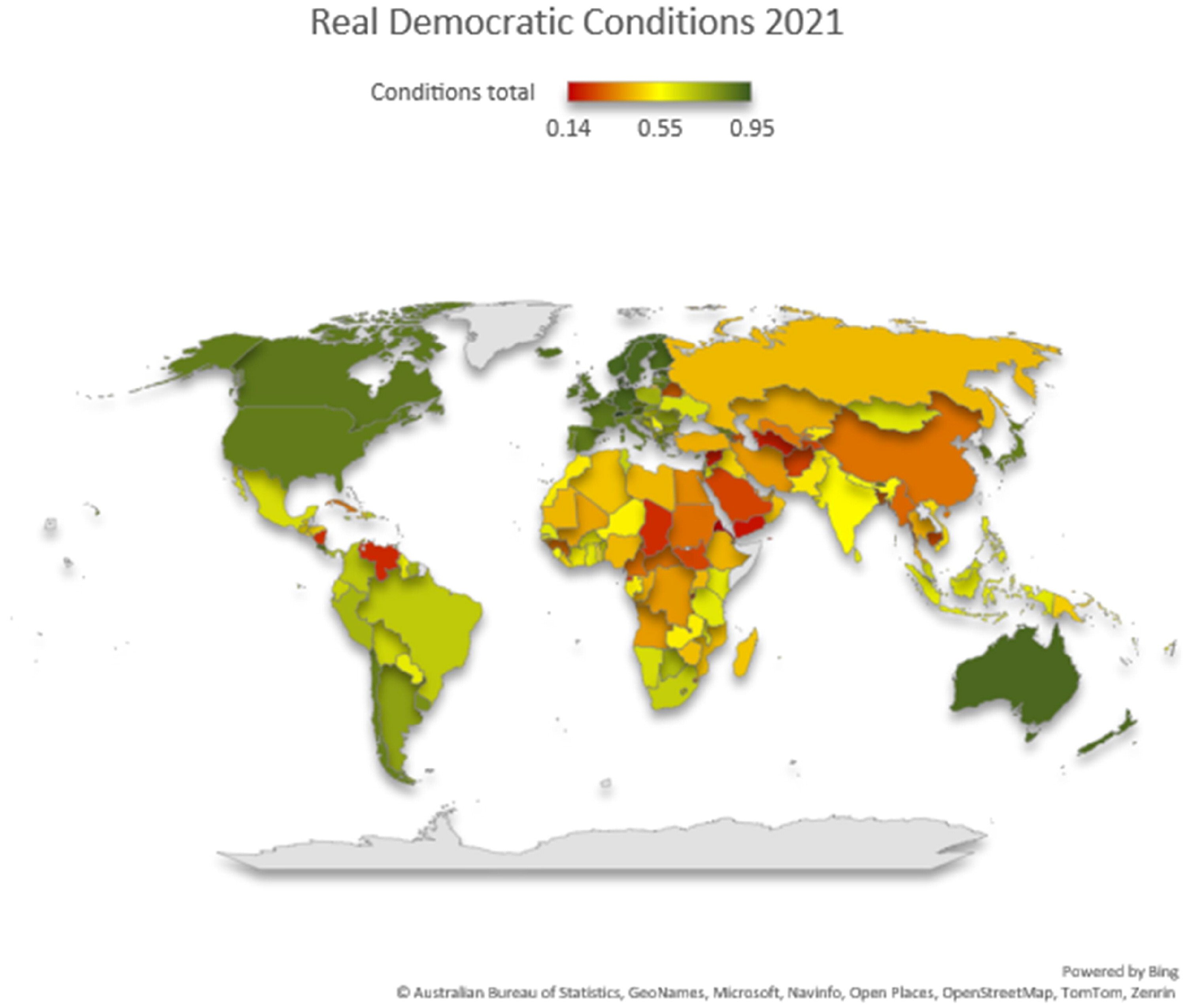
What does all this look like empirically? Critical realists can do quantitative analysis (contrary to myths) so it is an important and worthwhile exercise to remap global patterns of democracy. Using various data sources the article describes patterns of democratic conditions and compares this to outcomes. It also provides a short case study of the USA.
More to come in the book!

 Toby S. James